


Luxury Rugs for Trade That Specify Beautifully
- The Rug Story

- 11 minutes ago
- 6 min read
A rug is often the element that makes a scheme feel resolved. It establishes scale beneath a seating arrangement, introduces texture where hard finishes dominate and gives a carefully selected palette somewhere to settle. For designers sourcing luxury rugs for trade, the question is not simply whether a design looks beautiful on a sample board. It is whether the rug can be specified precisely, presented confidently and made to suit the room it is intended to serve.
A considered rug should work as part of the architecture of an interior. In a private residence, it may soften a grand drawing room or bring intimacy to a principal suite. In a hospitality or commercial setting, it must also respond to footfall, furniture movement and the practical demands of the space. The right trade partner helps turn that brief into a material, proportion and construction that will hold its place beautifully.
Why luxury rugs for trade need more than a collection
A curated collection is a valuable starting point, particularly when a project calls for a clear design language and a dependable route to specification. Design-led styles can bring immediate character to a scheme: an expressive line, a painterly motif, a refined border or the quiet confidence of a plain field. Yet even the most successful standard design may need adjustment once it meets the realities of a room.
Perhaps the blue needs to become a softened mineral grey to sit alongside a particular fabric. Perhaps the proportions need to change to accommodate a wide bay, an asymmetrical furniture plan or an architectural hearth. A standard 2.5 metre by 3.5 metre size can look perfectly composed in one setting and entirely wrong in another. Trade specification is where the difference lies: the ability to retain the spirit of a design while making it belong unequivocally to the project.
This is why bespoke capability matters. It gives interior designers control over colour, fibre, dimensions, border detail and pile treatment without forcing the scheme to compromise around an off-the-shelf product. The result should not feel customised for the sake of it. It should feel inevitable.
Begin with the room, not the rug
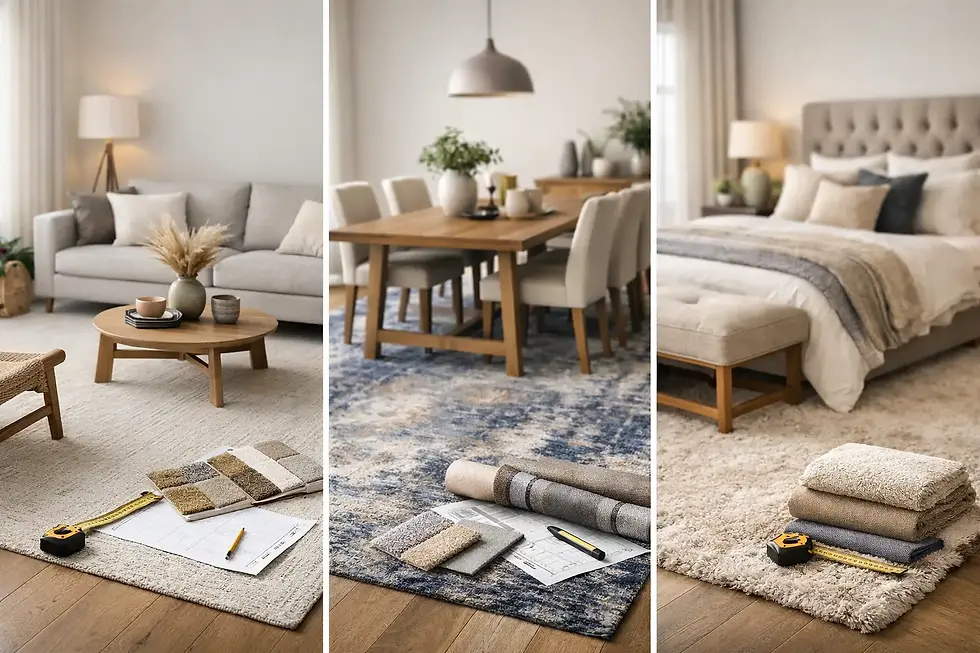
A successful specification starts with the furniture layout and circulation, rather than a nominal rug size. In living spaces, a rug that only catches the front feet of a generous sofa may be appropriate where a lighter, more open composition is intended. For a more formal arrangement, allowing the principal seating to sit fully on the rug creates a stronger sense of unity.
Dining rooms require particular discipline. The rug should extend sufficiently beyond the table so chairs remain on the pile when drawn back. In bedrooms, the decision is often between a full-room rug, a large rug set beneath the bed and bedside tables, or more discreet runners. Each option changes both the visual weight and the experience underfoot.
CAD drawings and room plans are valuable at this stage. They allow the designer to assess proportion before production begins and can prevent the familiar disappointment of a beautiful rug that appears undersized once installed. Consider door swings, radiators, floor grilles, hearths and fitted joinery too. These details shape the final dimensions as much as the central furniture grouping.
Scale gives pattern its authority
The same motif can read entirely differently at different sizes. Fine linework may become too busy when compressed, while a large-scale pattern can lose its gesture if reduced excessively. A floral or painterly design needs room for its movement. Conversely, a simple one-colour or two-colour construction can bring welcome calm to a space already rich in timber, stone, upholstery and artwork.
This is where an experienced rug specialist adds genuine value. The conversation is not just about enlarging or shrinking a file. It is about preserving the balance of the design, the cadence of the repeat and the visibility of the detail at the finished scale.
Choose pile construction for how the room will be used
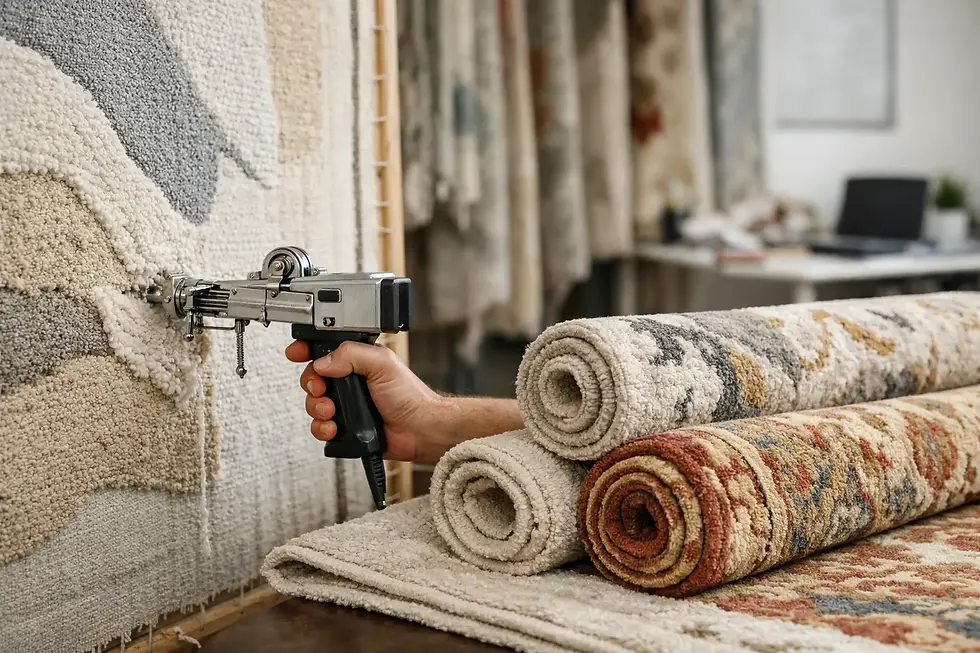
Hand-tufted rugs offer exceptional freedom for bespoke interiors, particularly when cut pile, loop pile and cut-and-loop construction are used with purpose. Each has a distinct visual and tactile contribution.
Cut pile has a plush, luxurious surface with a soft hand and a rich depth of colour. It is well suited to bedrooms, private lounges and areas where comfort is central to the brief. Depending on the fibre and pile height, it can create anything from a velvety, formal finish to a more relaxed and inviting feel.
Loop pile introduces a more textural, structured surface. It can give a design definition and subtle relief, making it particularly compelling for contemporary schemes, tonal patterns and interiors that benefit from a more architectural character. Loop pile can also be a sensible choice in areas requiring a firmer surface, although the exact fibre, loop height and setting must be considered carefully for the intended use.
Cut-and-loop pile brings both treatments together. This construction is especially useful when the design relies on contrast through texture rather than colour alone. A pattern can emerge through changes in pile level and light reflection, creating a refined effect that reveals itself gradually as one moves through the room. It is a pile of discovery: controlled, tactile and never unnecessarily loud.
No construction is universally superior. A deep cut pile may be exactly right for a master bedroom but less appropriate for a high-traffic corridor. A tightly considered loop construction may suit a busy reception area, but it should still be assessed alongside the furniture type and the expectations of the client. Luxury is not only about softness. It is about selecting the right performance and finish for the setting.
Colour should be specified in the context of the scheme
Digital visuals are useful, but they cannot replace the judgement that comes from seeing yarn and material samples beside the project palette. Daylight, artificial lighting, wall finishes and neighbouring textiles all affect how a colour is perceived. A warm ivory may look elegantly restrained beside limestone yet appear yellow against a cool white lacquer. A charcoal can bring graphic depth in one room and feel too severe in another.
Colour poms allow the designer to make these decisions with greater confidence. They are particularly valuable for bespoke work, where a rug may need to connect an otherwise disparate selection of fabrics, paints and finishes. A well-chosen rug colour does not need to match every element. Often, its role is to bridge them.
This approach also applies to contrasting pattern. The strongest designs frequently use a restrained palette, allowing shifts in pile, outline and scale to do the visual work. Collections inspired by artistic mark-making, such as the Grimaldi, Matisse, Monet, Pissarro and Sisley styles, can offer a starting point for this type of layered but composed interior narrative.
Build time into the specification process
A bespoke rug deserves early consideration in the programme, especially where colour development, client sign-off and fitting coordination are involved. The approval process should establish the finished size, fibre choice, pile construction, colour direction and any design amendments before manufacture begins. It is also wise to clarify access requirements, delivery timing and who will be responsible for laying the rug on site.
Short production times are valuable, but they should support thoughtful decision-making rather than encourage rushed specification. At The Rug Story, hand-tufted rugs can be manufactured in four weeks, followed by approximately two weeks for delivery from receipt of payment, including for international projects. That offers a practical advantage where programmes are moving, while still allowing the rug to be tailored rather than treated as an afterthought.
For projects outside Great Britain and Ireland, early discussion is especially useful. International delivery is entirely achievable, but the rug dimensions, site access, import arrangements and installation sequence should be agreed in good time. A large custom rug is not simply another parcel. It is a finished design element that needs to arrive ready for its moment.
Presenting the decision to the client
Clients rarely respond to a rug specification through technical data alone. They need to understand how it will change the room: how it will frame the furniture, temper acoustics, bring warmth to a stone floor or give a neutral scheme its necessary point of difference. CAD visualisation, colour poms and a clearly explained pile choice make the decision tangible.
There is also value in explaining what has been deliberately avoided. A bespoke rug may exclude a competing colour, reduce an overly busy pattern or use a more disciplined pile height to keep the room balanced. These are not compromises. They are acts of editing, and editing is often where a luxury interior becomes convincing.
The most rewarding specifications are those in which every decision has a reason: a border aligned to the architecture, a yarn selected for its character, a pile construction chosen for the way the space will be lived in. Give the rug that level of attention early, and it will do far more than cover the floor. It will hold the whole scheme together.

Comments