


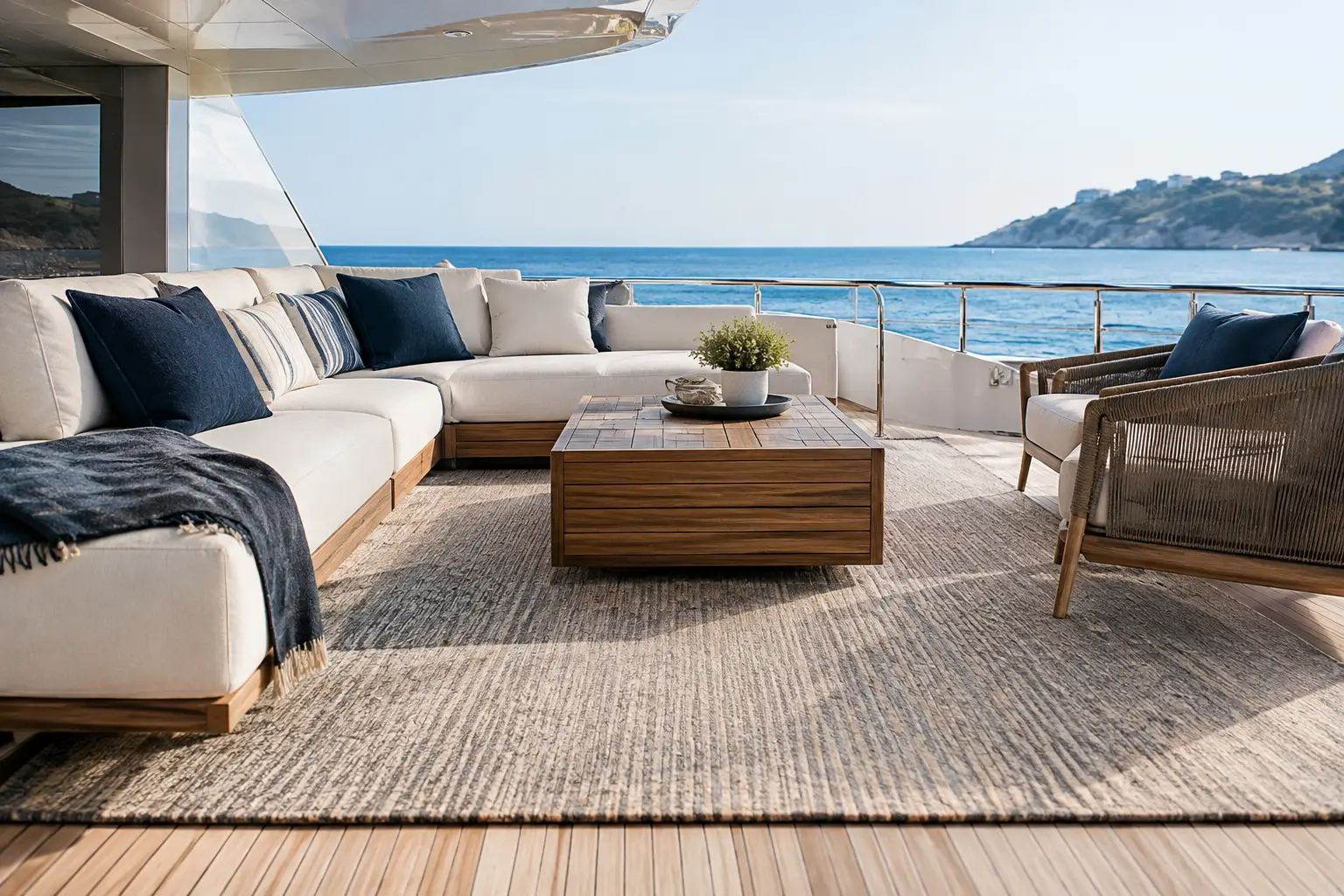
Rug Specification for Yachts Made Simple

A yacht rug is rarely an isolated finishing touch. It sits within a tightly considered scheme of joinery, upholstery, lighting, hardware and sea views, while also needing to cope with movement, moisture, intense daylight and demanding operational standards. A considered rug specification for yachts therefore begins well before colour is chosen: it starts with the vessel’s use, the location of the rug and the expectations of the owner, captain and project team.
For interior designers, the opportunity is considerable. A bespoke rug can soften the precision of lacquered cabinetry, introduce an artistic focal point to a saloon or bring a sense of quiet luxury to a private suite. The detail lies in specifying it with the same rigour applied to every other marine finish.
Start with the yacht’s intended use
The first question is not which design is most beautiful, but how the space will be used. A rug beneath a formal dining table on a privately owned motor yacht has different demands from one in a busy charter saloon. Equally, a loose rug in a lower-deck guest cabin faces a different set of conditions from a fitted piece in a bridge-deck lounge with broad glazing and regular traffic from the aft deck.
Consider the movement through the room, exposure to salt air, proximity to exterior doors, the likelihood of shoes being worn, and whether food and drink will be served nearby. Charter yachts usually call for a more forgiving construction and colour story, while a private vessel may allow for a more delicate, highly sculptural finish. Neither approach is inherently superior. The right decision is the one that respects how the yacht will genuinely be lived in.
It is also sensible to establish who will maintain the rug. A crew accustomed to luxury textiles may be comfortable caring for a fine natural fibre piece, provided they receive clear cleaning guidance. For a yacht with frequent guest turnover or limited storage and maintenance facilities, resilient materials and a lower-profile construction can be the wiser choice.
Fibre selection: beauty must earn its place
Fibre affects appearance, handle, performance and long-term care. It should be chosen for the precise setting, rather than by habit.
Wool remains a compelling option for yacht interiors because it has a naturally rich appearance, takes colour beautifully and offers a pleasing degree of resilience underfoot. Its inherent ability to recover from compression makes it especially suitable for lounge and cabin rugs where comfort matters. The natural variation in wool also gives a hand-tufted design depth that is difficult to replicate with purely synthetic fibres.
Silk and botanical silk alternatives can bring exceptional lustre and tonal movement, particularly in a master suite or low-traffic owner’s area. They are best used with a realistic understanding of their character. These fibres can show shading, pressure marks and changes in pile direction, all of which may be desirable in a refined scheme but are less suited to hard-working guest areas.
High-quality nylon or other performance-led fibres can be appropriate where practical durability, stain resistance and colour consistency are priorities. They are often a strong consideration for charter use, high-traffic corridors or areas close to the deck. A blended yarn can offer a balanced solution, combining the tactile quality of wool with the performance benefits of a man-made fibre.
The specification should record the fibre content clearly, rather than relying on a broad description such as ‘luxury wool blend’. This gives the designer, shipyard and crew a shared reference point for appearance and care.
Choose pile construction for the space
Hand-tufted rugs offer meaningful freedom in pile construction. Cut pile has a plush, velvety surface and lends itself to elegant, painterly designs. It is well suited to bedrooms, private lounges and spaces where the rug is intended to feel indulgent beneath bare feet.
Loop pile provides a more tailored texture and can be particularly effective in a contemporary yacht scheme. Its structured appearance works beautifully alongside linear joinery, woven wallcoverings and architectural upholstery. However, loops can be more vulnerable to snagging in certain circumstances, so the surrounding furniture, pet use and likely footwear should be considered.
Cut and loop pile combines these two treatments to create pattern through texture as well as colour. It is an excellent route to subtle geometry, coastal contours or abstract artwork without making the room visually busy. On board, where views and reflective finishes already provide visual interest, this restrained dimensionality can be more successful than an overtly decorative motif.
Pile height requires equal attention. A deep pile feels luxurious but may be less practical around dining furniture, cabin doors and movable seating. A lower pile can offer a neater, more stable finish and makes day-to-day vacuuming easier. Where chairs are moved frequently, a medium or low cut pile is usually more forgiving than a dense, deep construction.
Size, shape and placement need early coordination
A beautifully made rug can look accidental if its dimensions are not resolved against the furniture plan. On yachts, tolerances are often tighter than in residential projects, and curved cabinetry, floor hatches, service panels and built-in furniture can all influence the final shape.
For a saloon seating arrangement, the rug should either accommodate all principal furniture legs or sit deliberately beneath the front legs of sofas and occasional chairs. A narrow rug floating in the middle of a generous lounge can make even an exceptional interior feel under-scaled. In dining spaces, allow sufficient projection beyond the table so chairs remain on the rug when drawn back.
Templates, detailed CAD drawings and an agreed datum point are particularly valuable for irregular footprints. A rug may need radiused corners, a shaped edge following cabinetry or precise cut-outs for floor fittings. These should never be left to site judgement alone. A full-size template is often the most dependable route where the shape is complex or the fitting tolerance is exacting.
There is also a choice between loose-laid and fitted rugs. A loose piece can be removed for cleaning or seasonal refreshment, and may be preferable in guest areas. A fitted rug creates a more integrated look but requires meticulous measurement, appropriate edge detailing and a clear plan for access to hatches or technical areas beneath.
Safety and compliance belong in the brief
Marine projects bring requirements that should be confirmed at the outset with the yacht’s project manager, flag administration, classification body, insurer and, where relevant, the shipyard. Fire performance, smoke production, anti-slip provision and material documentation may be governed by the vessel’s category, flag and operational use. Requirements can differ significantly between a private yacht and a commercially operated charter vessel.
Do not assume that a domestic rug certification will satisfy a marine requirement. Ask early which test standard, documentation and approval route is required for the specific project. If a rug needs to meet a particular standard, that requirement must inform the fibre, backing, adhesive and finishing choices before sampling and manufacture begin.
Underfoot stability is equally important. A dedicated underlay or integrated anti-slip treatment may be necessary, especially on polished timber, stone or other smooth floor finishes. The solution needs to work with the flooring manufacturer’s guidance and should avoid leaving residue or creating a moisture trap. It should also be assessed in relation to the vessel’s normal movement, not only when dockside.
Design for light, salt and visual calm
Sunlight is one of the defining elements of yacht interiors. It can animate a rug’s texture during the day, but it can also place pressure on colour over time. In spaces with expansive glazing, discuss lightfastness expectations openly and consider how the palette will behave in direct Mediterranean, Caribbean or equatorial light.
Pale shades are not automatically impractical, nor are dark shades automatically safer. A pale, heathered ground can disguise sand and light debris effectively, while a solid dark pile may reveal lint, salt residue or footprints. Mid-tones, nuanced neutrals and pattern with tonal variation often offer the best balance between visual sophistication and everyday forgiveness.
Scale matters too. A large motif that appears balanced in a studio may feel overwhelming in a compact cabin. Conversely, a fine pattern can disappear against strongly figured veneers or patterned upholstery. Requesting a CAD visualisation or carefully reviewed strike-off helps the team judge the rug in relation to the wider scheme, rather than as a standalone sample.
Specify the finish, not only the face yarn
The quality of a yacht rug is expressed at its edges and underside as much as across its surface. Binding, serging, hand-finishing and backing should be selected to complement the design and the installation method. A tonal border may frame a formal composition, while an almost invisible edge can let an organic shape read as part of the floor architecture.
The reverse of the rug deserves a technical conversation. Backing contributes to stability, weight, flexibility and suitability for the chosen floor. It must be compatible with the intended underlay or fixing method and proportionate to the practicalities of lifting, moving and maintaining the piece. A specification should set out the finished dimensions, tolerances, pile composition, pile height, backing, edge finish, weight, placement and care requirements.
For bespoke work, colour poms and physical yarn samples are invaluable. Screen colours are useful for discussion, but they cannot show the true interaction of fibre, texture and light. A hand-tufted rug has character precisely because the surface responds to its materiality.
Build enough time into the project programme
Yacht programmes can be exacting, particularly as final measurements and joinery details are often confirmed late in the build. The rug should be scheduled early enough for sampling, approvals and manufacturing, while allowing for final site verification before fitting. Rushing a shaped rug after flooring has been installed is rarely economical.
For trade professionals, a specialist partner can make this process more controlled through design consultation, colour development, CAD drawings, size guidance and coordinated fitting advice. The Rug Story creates bespoke hand-tufted rugs across cut pile, loop pile and cut-and-loop constructions, helping designers translate a scheme into a considered textile specification.
A yacht rug should feel effortless once installed: perfectly proportioned, quietly secure and entirely at home among the vessel’s finishes. That apparent ease is the result of early questions, exact documentation and a willingness to give craftsmanship the same attention as the view beyond the glass.


Comments