


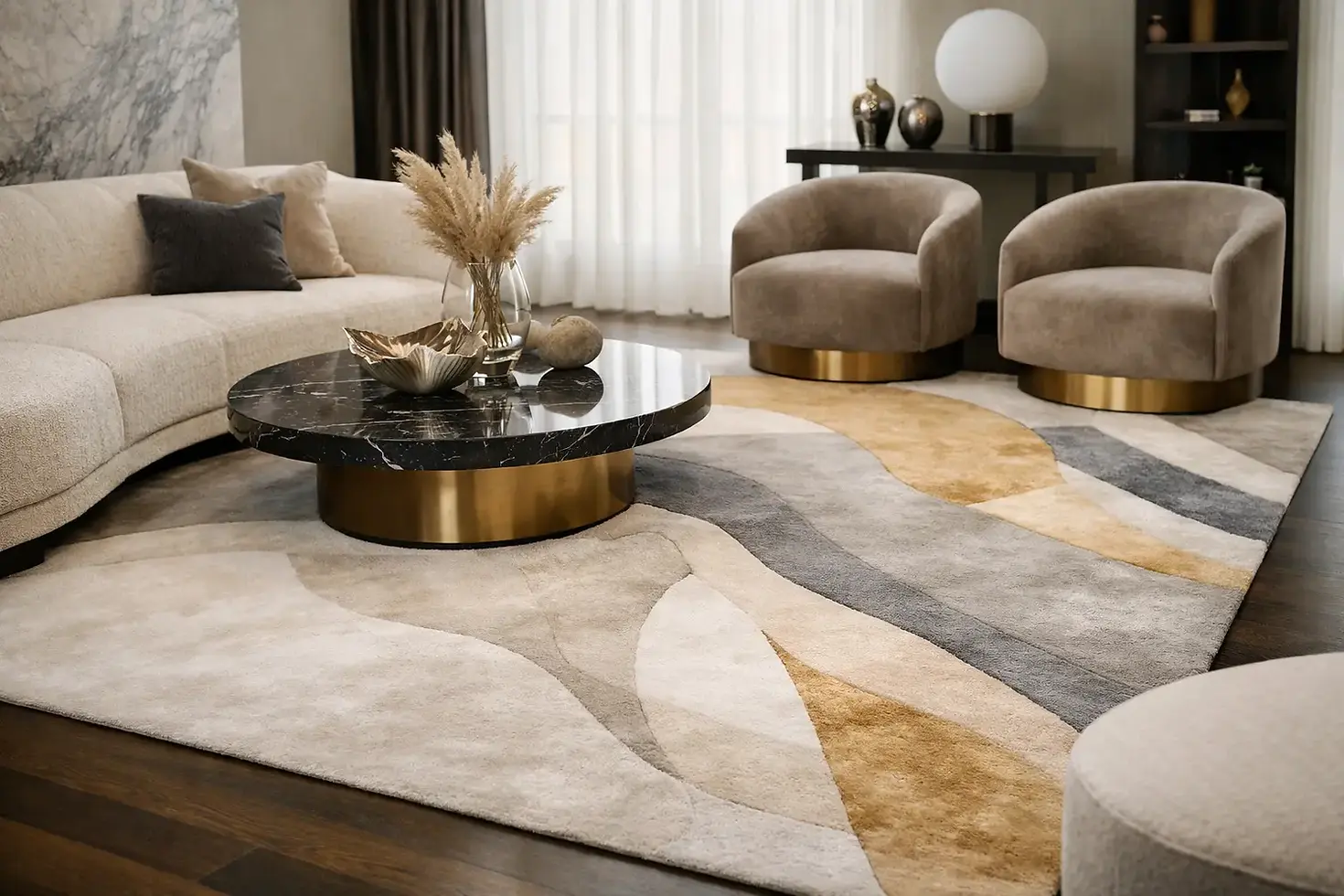
Top Bespoke Rug Design Ideas for Luxury Interiors

A rug is often the largest uninterrupted field of colour and texture in a room. Get it right and it gives furniture, artwork and architecture a common language. Get it wrong and even a beautifully furnished scheme can feel unresolved. The strongest top bespoke rug design ideas begin not with a pattern in isolation, but with the room’s proportions, circulation, light and intended atmosphere.
For interior designers, bespoke hand-tufted rugs offer a particularly precise way to carry a scheme from concept to installation. Colour can be moderated rather than matched literally, a motif can be enlarged to suit the architecture, and pile construction can introduce relief without relying on additional decorative elements. The result should feel considered underfoot and convincing from every angle of the room.
Top Bespoke Rug Design Ideas to Specify with Purpose
1. Build depth with cut and loop pile
Cut and loop construction is one of the most effective ways to add dimension while keeping a design refined. A cut pile section catches the light and feels soft and generous; a loop pile section has a more tailored, textural quality. Used together, they can create a subtle line drawing, a raised motif or a low-relief geometric field.
This approach works particularly well in reception rooms, boutique hospitality spaces and principal bedrooms where the rug needs visual presence without becoming overly decorative. Consider a tonal palette - perhaps warm stone over oatmeal, or ink over deep mineral blue - so that the texture becomes the principal feature. In stronger schemes, the raised cut pile can trace a colour boundary or repeat a form already present in the joinery, wall panelling or upholstery.
The trade-off is practical as much as aesthetic. High contrast between pile types will show the pattern clearly, while close tones create a quieter, more architectural finish. The latter may be preferable where daylight is strong or the room already includes expressive artwork.
2. Let the architecture determine the scale
A bespoke design has the advantage of being drawn for the actual room rather than adapted from a standard size. That changes the whole reading of the floor. A large-format motif can sit comfortably in a generous drawing room, while a narrow repeat may make a long corridor feel intentional rather than merely functional.
Before establishing pattern scale, map the key elements: sofa feet, occasional chairs, dining table perimeter, fireplace projection, door swings and primary walking routes. In a living room, the rug should usually create a complete furniture island rather than leave front legs perched on a narrow edge. Under a dining table, allow enough extension beyond each chair for it to remain on the rug when drawn back.
CAD visualisation is invaluable at this point. It allows the design team and client to assess not only the footprint but where a central medallion, border or asymmetrical feature will land in relation to the furniture. A pattern that looks balanced in a square sample can feel misplaced once a chaise, bay window or offset fireplace enters the plan.
3. Use an irregular border to soften formal rooms
A conventional border is timeless, but it need not be rigid. An irregular edge, painterly outline or broken linear frame can bring movement to a formal interior while preserving the composure of a bordered rug. This is especially useful where the architecture is classically proportioned and the furniture profile is contemporary.
The border can be expressed through a change in pile height, a small shift in tone or a contrasting yarn. A restrained two-colour version often has greater longevity than a heavily detailed composition. Think of a pale ground interrupted by a charcoal contour, or a deep moss field with a quieter olive perimeter.
This idea also offers a practical solution when a room has awkward dimensions. The visual frame can be adjusted to sit evenly around the furniture arrangement rather than following the rug edge mechanically. It gives the designer room to resolve proportion with more finesse.
4. Translate artistic references rather than reproducing them
Artistic inspiration can give a bespoke rug a strong identity, but direct reproduction is rarely the most elegant route. Instead, extract a quality from the reference: the softened colour transitions of an Impressionist painting, the rhythm of a gestural mark, the geometry of a modernist composition or the quiet drama of a monochrome sketch.
A hand-tufted rug is particularly suited to this translation because colour, line and texture can work together. A blurred brushstroke may be rendered in gently graduated yarn shades; a graphic composition may use crisp cut pile against loop pile; a layered mark can become a sequence of reliefs. The final design remains original to the project rather than reading as a literal artwork placed on the floor.
For client presentation, start with the scheme’s existing material palette. Select three or four meaningful colours from curtains, stone, timber, wall finish or an artwork, then decide which should lead and which should recede. Colour poms make this process more dependable than working from a screen, where texture and undertone are easily lost.
5. Create quiet drama with a tonal field
Not every luxury rug needs a prominent motif. A nearly plain rug with nuanced tonal movement can be the most sophisticated choice for spaces where the joinery, views or art collection should lead. The design might use closely related shades arranged in soft blocks, broad bands or an almost imperceptible fade.
This direction is ideal for layered neutral schemes, but it is equally compelling in saturated interiors. A tonal aubergine, forest green or midnight blue rug can anchor a room with depth while avoiding the visual interruption of a high-contrast pattern. Cut pile offers a fuller, velvety appearance, whereas loop pile brings a drier, more tailored texture. The correct choice depends on the furniture textiles and the desired level of formality.
A tonal field also rewards close consideration of fibre. Wool provides natural character, resilience and a rich take on colour. Silk or botanical silk accents can add light-catching refinement, though they are best positioned with the traffic level in mind. A busy family room and a private dressing room do not ask the same things of a rug.
6. Make the rug a connector between materials
The most successful bespoke rugs often reconcile elements that might otherwise sit apart. A room with pale oak, antique bronze, ivory boucle and deep blue lacquer does not need every finish repeated exactly. It needs a measured connection between them.
A rug can provide that bridge through a carefully calibrated palette: a warm neutral base to reflect the timber, a fine bronze line to acknowledge metalwork, and a restrained blue accent to relate to the lacquer. The pattern itself may be simple - interlocking curves, fractured checks or a wide linear repeat - because the colour story is doing much of the work.
This is where simple one- and two-colour designs deserve serious attention. Their apparent restraint makes them adaptable across periods and project types, from contemporary townhouses to considered commercial interiors. A clear composition also reduces the risk of a rug competing with complex fabrics or statement stone.
7. Use asymmetry where the plan calls for it
Symmetry remains powerful, particularly beneath a centred dining table or in a formally arranged sitting room. Yet an asymmetrical design can be more appropriate in open-plan spaces, rooms with off-centre fireplaces or layouts shaped around a view. A sweep of colour, offset block or directional line can gently guide the eye through the plan.
The key is to make the asymmetry feel deliberate. Relate it to something fixed in the architecture or furniture layout, such as the line of an island, a window wall or the angle of a sectional sofa. Without that relationship, a dynamic design can appear accidental once the room is furnished.
A dedicated rug specialist can help test these decisions before production, from confirming the finished dimensions to refining pile direction, yarn shades and fitting considerations. The Rug Story’s bespoke service is designed for this level of project-specific development, combining hand-tufted craftsmanship with CAD drawings, colour poms and trade-focused support.
From Concept Board to Finished Rug
The specification process is most effective when it begins early, ideally once the furniture plan and core finishes are established. Bring the rug into the conversation before upholstery and window treatments are fully signed off, rather than treating it as a final decorative layer. This gives the floor finish the influence it deserves and avoids last-minute colour compromises.
Allow time for samples to be viewed in the project lighting, especially where a rug includes subtle tonal shifts or contrasting pile structures. Natural light can amplify sheen, while warm artificial light may bring out unexpected undertones. It is also worth discussing maintenance expectations with the client from the outset. A luxurious fibre choice can be entirely appropriate, but it should suit how the room will actually be lived in.
The best bespoke rug does more than fill a measured area. It establishes rhythm, comfort and visual confidence beneath the furniture, then lets the rest of the room feel exactly where it belongs.


Comments