


How to Order Trade Rugs for Design Projects
- The Rug Story

- Jul 13
- 6 min read
A rug can make the scheme feel resolved, but it is often one of the final pieces to be specified. By that point, furniture layouts may have shifted, curtains may be in production and the client may be expecting a precise finish. Knowing how to order trade rugs early and intelligently protects the design intent, the programme and the presentation of the room.
For a luxury residential or hospitality project, ordering is not simply a matter of selecting a design and confirming a size. It is a considered specification process: one that brings together proportion, pile construction, yarn colour, edge treatment, access and installation. The earlier those details are discussed, the more confidently the finished rug will sit within the wider interior.
Begin with the room, not the rug
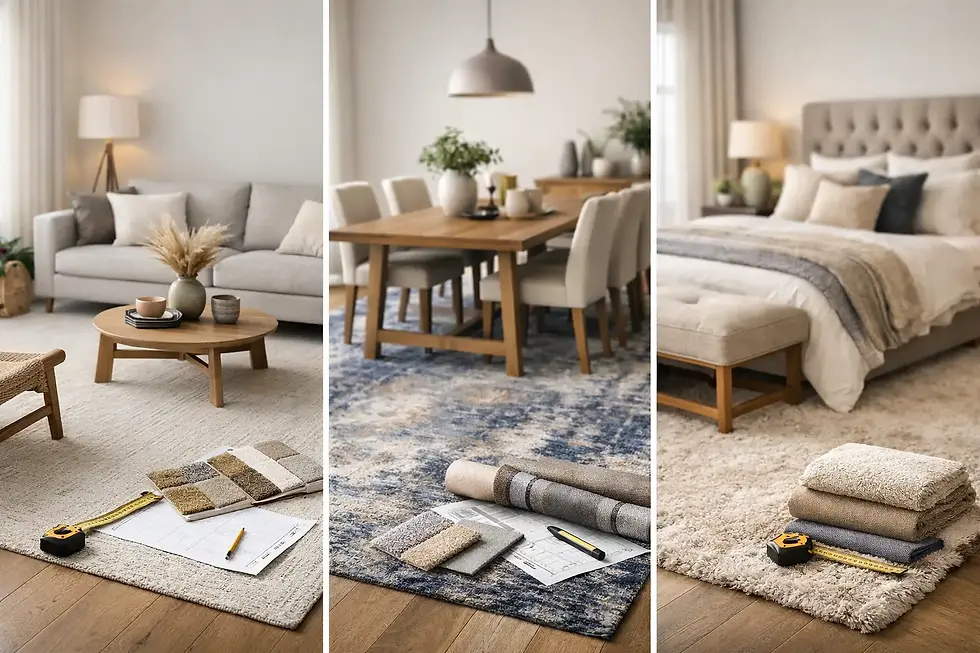
The best rug specifications start with a plan. A floorplan confirms more than dimensions: it shows circulation routes, door swings, furniture footprints and the visual centre of the room. A rug that looks generous in isolation can feel undersized once seating is in place, while an ambitious scale can become impractical if it catches a door or restricts access.
For a living space, consider whether the front legs or all legs of the seating should sit on the rug. In a dining room, allow enough perimeter for chairs to remain on the pile when pulled back. Bedrooms call for a different judgement. A large, centred rug may create a calm, enveloping composition, whereas runners or two smaller rugs can be more appropriate where a bed frame, joinery or threshold dictates the layout.
Send the supplier a dimensioned plan wherever possible, together with photographs of the site and furniture dimensions. This creates a proper basis for size and fitting guidance rather than relying on an estimate from a moodboard.
Allow for real-world tolerances
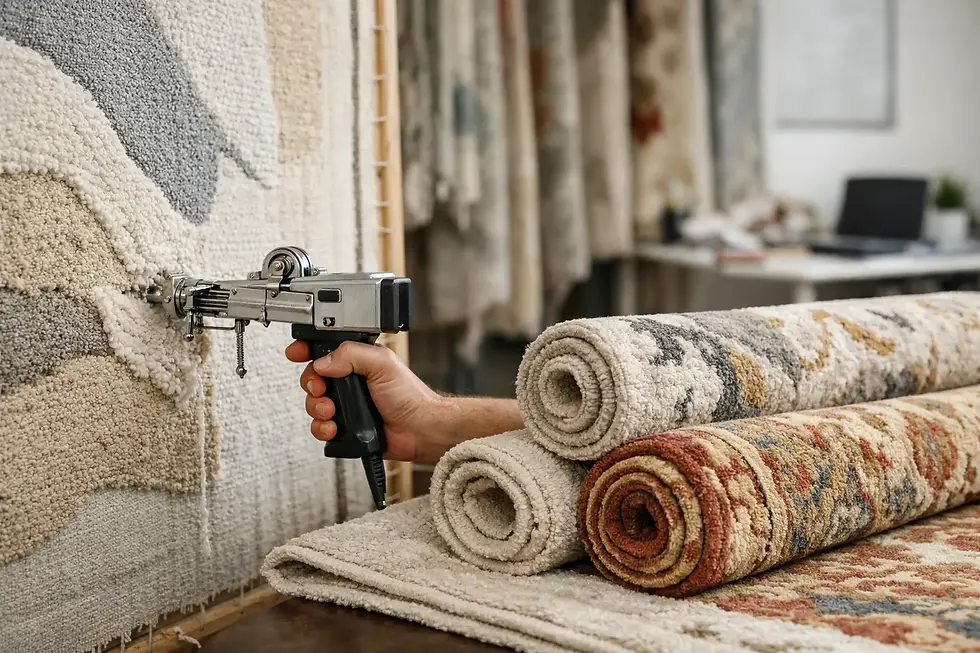
Hand-tufted rugs are made by hand, and floorplans do not always reflect site conditions perfectly. Measure at the point of installation before releasing a bespoke order, particularly where there are chimneys, curved walls, fixed joinery or uneven alcoves. If the rug will sit beneath a loose piece of furniture, confirm the actual footprint rather than working from a catalogue dimension.
For wall-to-wall or shaped pieces, a template may be the sensible route. It depends on the complexity of the perimeter and whether the final floor finish is already in place. A little care here prevents an otherwise beautiful rug from becoming a fitting compromise.
Choose a construction that supports the scheme
Pile is not merely a textural decision. It changes how colour reads, how light moves across the surface and how the rug performs underfoot. Cut pile offers a luxurious, velvety finish with a rich depth of colour. It is particularly effective in bedrooms, drawing rooms and spaces where softness and visual refinement lead the brief.
Loop pile brings a more tailored texture and can suit schemes that call for subtle pattern or a slightly more architectural surface. Cut and loop pile combines the two, creating relief, movement and tonal contrast without necessarily introducing additional colours. It is often an elegant answer when a client wants interest but the overall palette needs restraint.
Traffic, intended use and maintenance expectations should shape this choice. A deeply tactile construction may be exactly right for a private suite but less suited to a heavily used circulation area. Equally, a tightly considered loop or cut-and-loop design can bring sophistication to a commercial setting without looking overly utilitarian.
Fibre selection matters alongside construction. Wool remains valued for its natural resilience, warmth and ability to hold colour beautifully. Silk or silk-effect accents can add a gentle sheen and define a motif, although their placement should be judged according to wear. Discuss the room’s use openly at the outset. A supplier can only specify well when the practical demands are clear.
How to order trade rugs from a design concept
A concept board is a starting point, not a full rug specification. Once the scheme is approved, translate the visual language into decisions that can be sampled, drawn and costed. This normally includes the overall dimensions, the chosen design or bespoke artwork, pile construction, colours, fibre content and any shaped outline or border detail.
A one-colour rug can be as exacting as an expressive pattern. Its success may depend on matching the undertone of plaster, linen or timber, then choosing whether a cut pile or loop pile gives the desired depth. For a more decorative approach, designs such as Grimaldi, Matisse, Monet, Pissarro or Sisley offer a considered foundation that can be adapted to a project palette. Bespoke development allows the scale, colours and composition to respond to the room rather than forcing the room to fit a standard format.
CAD drawings are particularly valuable at this stage. They clarify proportion, placement and pattern repeat before production begins, giving the designer a polished visual tool for client presentation. For unusual room shapes or designs with a strong directional motif, insist on reviewing the drawing at the intended scale and orientation. A border that appears balanced on screen can need adjustment once its relationship with doors, fireplaces or furniture is understood.
Use colour poms to make the final call
Screen colours and printed visuals cannot replace yarn poms. Light temperature, surrounding materials and the pile itself all influence perception. Review colours in the project environment where possible, especially if the scheme contains warm white paint, veined stone, coloured lacquer or daylight that changes throughout the day.
Ask to see adjacent colours together, not in isolation. The point is not always to match exactly. Sometimes the right choice is a quiet tonal shift that lets the rug support rather than compete with the upholstery. Where a design uses cut and loop construction, review how each yarn behaves in its respective pile as well as how it looks in a colour pom.
Confirm approvals before production
A clear approval process protects every party. Before an order is released, check the final quotation against the drawing and written specification. Confirm dimensions in millimetres or centimetres, construction, fibre, colour references, design orientation, edging and delivery address. If there is a particular focal direction, such as a bed end or a view towards a fireplace, state it explicitly.
This is also the moment to confirm access. Large rugs can be substantial to handle, and properties with tight staircases, lifts or restricted entrances may require a delivery and fitting plan. Consider whether the rug needs to be carried, folded or positioned before other furniture arrives. For international projects, allow time for the delivery arrangements and any local import requirements.
Payment timing should be treated as part of the programme. Manufacturing lead times begin from receipt of payment, not from a preliminary design discussion or verbal sign-off. The Rug Story can manufacture rugs in four weeks, followed by an estimated two-week delivery period, giving designers a notably responsive route for bespoke work. Even so, build in contingency for site changes, client approvals and the occasional requirement for revised samples.
Plan fitting as carefully as procurement
The final reveal is where a good specification proves itself. Ensure the room is clean, dry and sufficiently complete before fitting. Newly laid floors, decorating works and incomplete joinery can put a finished rug at unnecessary risk. If the rug is being placed beneath heavy furniture, decide in advance whether pieces will be moved into position after installation or carefully set down once the rug is laid.
Underlay may be appropriate depending on the floor finish, the pile construction and the desired feel underfoot. It can improve stability, add comfort and help the rug sit more evenly, but it should be selected for the project rather than assumed as standard. On smooth stone, timber or polished concrete, slip resistance deserves particular attention.
Once installed, inspect the rug in the room’s natural and artificial light. Check the orientation, ensure edges are lying correctly and photograph the finished composition for the project record. A hand-tufted rug has character, and a short settling period after transport is normal. The aim is not sterile uniformity, but a beautifully made finish that feels entirely intentional.
A trade rug order is at its strongest when it is treated as a design collaboration rather than a late-stage purchase. Bring the plan, palette and practical constraints into the conversation early, and the final piece can do what exceptional rugs do best: give the room its sense of proportion, softness and lasting distinction.

Comments